The Angular Momentum of a Cast: Why Round Reels Still Matter
Update on March 21, 2026, 7:53 a.m.
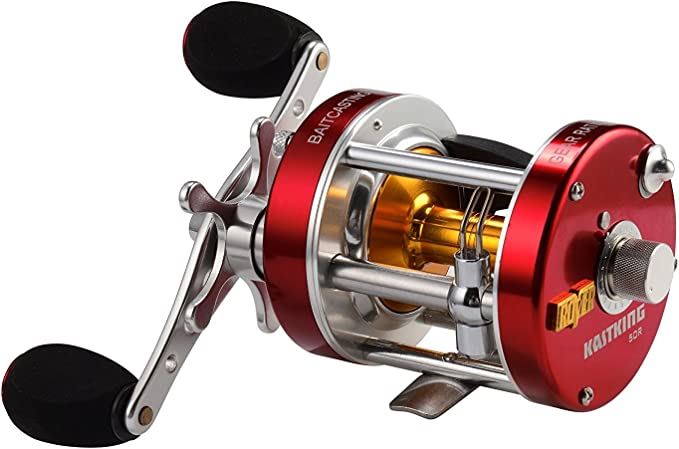
The physics of a casting reel begins with a paradox. When an angler releases the spool, the line must accelerate from zero to speeds exceeding 100 miles per hour in milliseconds. Yet that same spool must stop instantly when the bait lands, or the excess line tangles into the dreaded “bird’s nest” backlash. Managing this transition—controlling angular momentum through the entire cast cycle—defines the fundamental engineering challenge of baitcasting reel design.
The KastKing Rover round baitcasting reel represents the traditional approach to this challenge. Its circular form factor, unchanged in principle since Abu Garcia introduced the iconic Ambassadeur in 1952, embodies specific physics that modern low-profile designs deliberately trade away for ergonomics. Understanding these physics reveals why round reels still dominate certain applications despite the industry’s shift toward sleeker profiles.
The Rotational Inertia Principle
A casting reel’s spool rotates during the cast. This rotation carries angular momentum—the product of the spool’s moment of inertia and its angular velocity. The moment of inertia depends on both the mass of the rotating object and how that mass is distributed relative to the axis of rotation. For a cylinder like a reel spool, the formula is I = ½mr², where m is mass and r is radius.
This formula explains why spool design matters fundamentally. A larger-diameter spool has more rotational inertia at the same mass than a smaller one. That inertia resists changes in rotation speed—it takes more energy to accelerate, but also more braking force to decelerate. The spool becomes a flywheel, storing energy that smooths out the acceleration spike of the cast but complicates the deceleration at landing.
Round reels like the KastKing Rover typically feature larger-diameter spools than low-profile equivalents. The Rover 60 series spool measures approximately 35mm in diameter, compared to 30mm or less for many low-profile reels. This 17% increase in diameter translates to roughly 35% more rotational inertia for the same spool mass (since inertia scales with the square of radius).
The Trade-Off: Smoothness vs. Control
The additional rotational inertia of a large-diameter spool creates both advantages and disadvantages. During the cast, the flywheel effect smooths acceleration. The spool doesn’t spike to excessive speed as quickly; the energy from the casting motion transfers more gradually into line speed. Many anglers describe this as a “smooth” or “controlled” feeling—the reel seems to cast itself rather than requiring constant thumb pressure.
The disadvantage emerges at the end of the cast. When the bait lands and the line should stop, that same rotational inertia keeps the spool spinning. The angler must apply more thumb pressure to brake the spool, or risk overrun and backlash. Low-profile reels with smaller spools have less rotational inertia, making them easier to stop but also easier to overspeed.
This trade-off explains the historical division of reel applications. Round reels excel where smooth, powerful casts matter more than instant stopping control—trolling, deep-water jigging, heavy-bait casting. Low-profile reels dominate where precision matters more than power—finesse techniques, frequent casting, accurate placement of light lures.
Line Capacity and the Radius Factor
The larger diameter of round reel spools provides another advantage: line capacity. A spool’s line capacity scales approximately with the square of its radius (πr² times spool width times line diameter). A 35mm spool holds about 36% more line than a 30mm spool of equal width.
For certain applications, this capacity is essential. Musky fishermen throwing large baits, offshore anglers pursuing tuna or kingfish, catfish specialists targeting fish that run hundreds of yards—all require line capacity that low-profile reels struggle to provide. A typical round baitcaster holds 200-300 yards of 17-pound monofilament; low-profile equivalents often max out at 150 yards of lighter line.
The capacity advantage also affects line management. A spool holding more line experiences less line stacking at particular diameters. Line stacking—where line builds up unevenly on the spool—creates casting friction and increases backlash risk. Round reels with generous capacity can fish longer between line management sessions.
The Ergonomic Counterargument
If round reels offer physics advantages for heavy applications, why have low-profile reels dominated the market? The answer lies in ergonomics. A round reel’s form factor doesn’t fit naturally in the human hand. The circular body requires the angler to grip around a shape that doesn’t conform to palm geometry. Extended casting sessions produce fatigue, cramping, and for some anglers, actual injury.
Low-profile reels emerged specifically to address this ergonomic limitation. Their flattened shape nestles into the palm, allowing a natural grip with fingers wrapping around the reel foot. The design reduces hand fatigue dramatically, enabling the high-frequency casting that tournament bass fishing demands.
The physics trade-off is explicit: low-profile reels sacrifice spool diameter and rotational inertia for comfort. The industry has largely accepted this trade-off because most freshwater applications don’t require the maximum capacity and power that round reels provide. Bass fishing rarely demands more than 100 yards of line; 30mm spools suffice.
The Torque Multiplication Effect
Beyond spool physics, round reels offer mechanical advantages through their gear systems. The larger body accommodates larger gears with more teeth engaged simultaneously. This increases gear strength and distributes load across more surface area.
More significantly, round reels often feature lower gear ratios—typically 5.3:1 or 5.4:1 compared to the 7.1:1 ratios common in low-profile reels. Lower ratios multiply torque at the expense of retrieval speed. Each handle turn rotates the spool fewer times but with greater mechanical advantage.
For anglers fighting large fish, this torque multiplication matters. A 20-pound musky doesn’t tire quickly; the fight might last 15 minutes of constant reeling against substantial resistance. A high-speed reel requires more force per turn; the angler fatigues. A lower-ratio round reel moves the fish with less effort per handle rotation, preserving the angler’s stamina for the fight.
The KastKing Rover exemplifies this approach with its 5.3:1 gear ratio. The design prioritizes power over speed, accepting slower line retrieval for increased cranking force. The engineering assumption is that Rover users target species where power matters more than rapid lure presentation.
The Braking System Evolution
Modern round reels have incorporated the braking advances developed for low-profile reels. Centrifugal brake systems, magnetic brakes, and hybrid designs allow finer spool control than traditional round reels offered. The KastKing Rover includes a centrifugal braking system with adjustable weights, enabling anglers to tune the spool’s deceleration characteristics.
This evolution addresses the traditional criticism of round reels: their tendency to backlash. The large spool’s rotational inertia, which resists acceleration, also resists deceleration when braking is applied. Modern brake systems provide additional stopping force, partially compensating for the spool’s flywheel effect.
However, the fundamental physics remains unchanged. A larger spool with more rotational inertia will always require more braking force to stop than a smaller spool. The brake system can help manage this requirement but cannot eliminate it.
The Drag System Advantage
Round reels typically feature larger drag washers than low-profile equivalents. The larger diameter of the drag stack provides more surface area for friction material, distributing heat and wear across a greater area. For applications involving extended fights—tuna, sharks, large catfish—this drag capacity prevents the overheating and fade that smaller systems experience.
The KastKing Rover’s multi-disc drag system exemplifies this advantage. The carbon fiber washers spread across a larger diameter than would fit in a low-profile body, enabling the 17-22 pounds of drag that heavy freshwater and light saltwater applications demand.
The Maintenance Factor
Round reels have another practical advantage: accessibility. The larger body provides more room for internal components, making disassembly, cleaning, and lubrication easier. Parts are generally less crowded, reducing the risk of damage during maintenance.
Low-profile reels pack the same functional components into less space. The compact design looks sleek but complicates service. Tiny screws, tightly packed gears, and minimal clearances make maintenance more challenging and increase the risk of assembly errors.
For anglers who maintain their own equipment—particularly those fishing saltwater environments requiring frequent cleaning—round reels offer practical advantages beyond their performance characteristics.
When Physics Favors the Round
The decision between round and low-profile reels ultimately reflects an angler’s priorities. Round reels offer physics advantages: larger spools for more line capacity, greater rotational inertia for smoother casting, lower gear ratios for more torque, larger drag systems for extended fights. These advantages matter for specific applications: trolling, heavy-bait casting, large-species pursuit, saltwater fishing.
Low-profile reels offer ergonomic advantages: better hand fit, reduced fatigue, easier casting control. These advantages matter for applications involving frequent, repetitive casting: tournament bass fishing, finesse techniques, recreational angling where comfort affects enjoyment.
The KastKing Rover occupies the space where physics still trumps ergonomics. For anglers throwing heavy swimbaits, trolling for walleye, pursuing catfish in current, or targeting any species where line capacity and cranking power matter more than casting frequency, the round reel’s physics advantages justify its ergonomic compromises. The angular momentum that makes a large spool harder to stop also makes it cast more smoothly. The rotational inertia that complicates braking also stabilizes acceleration. These are not bugs in the round reel design—they’re features chosen for specific applications.


