The Maglev Advantage: Why Sonic Tech beats Manual Scrubbing
Update on Jan. 4, 2026, 9:27 p.m.
Here is a contrarian truth: Most children are physically incapable of brushing their teeth correctly. The “Bass Method”—angling bristles at 45 degrees and vibrating gently—requires fine motor skills that don’t fully develop until age 8 or 9. When a child uses a manual brush, they tend to scrub horizontally, missing the gumline and wearing down enamel.
The ORAL MASTER Kids Sonic Toothbrush is not just an automated scrubber; it is a technological compensation for developing motor skills. At its heart sits a piece of advanced engineering: the Maglev (Magnetic Levitation) Motor (Hook).
The Heart of the Machine: Maglev Physics
Traditional electric toothbrushes use eccentric rotating mass motors (ERM) that create vibration through unbalance. This is noisy, inefficient, and vibrates the handle as much as the head.
The Maglev Difference: The ORAL MASTER uses magnetic fields to suspend and drive the output shaft.
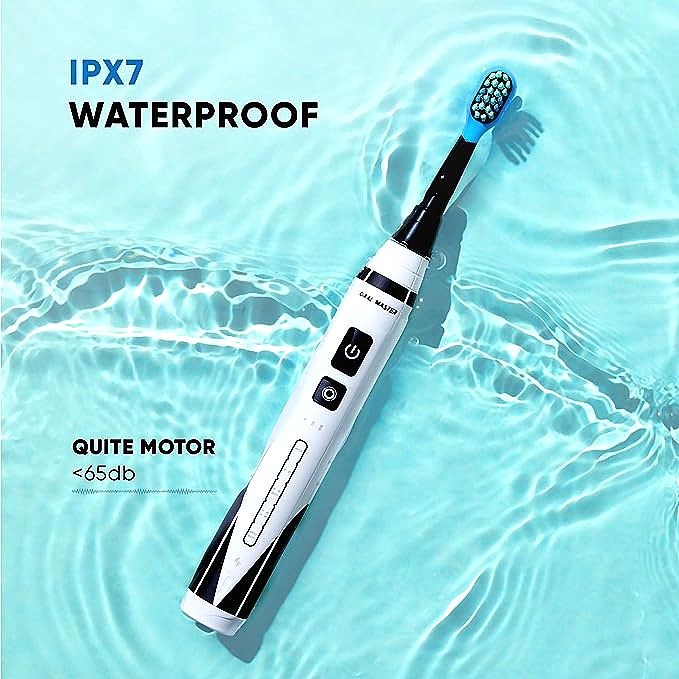
* Low Friction: Without physical gears grinding, the motor is quieter (protecting sensitive ears) and lasts longer.
* Focused Energy: The vibration is channeled directly to the brush head. The handle remains relatively stable, preventing the “numbing hand” sensation that scares many kids away from electric brushes.
* 36,000 VPM: This frequency allows the bristles to sweep back and forth faster than the human eye can see.
Fluid Dynamics: Cleaning Beyond the Bristles
The true power of 36,000 vibrations per minute is Fluid Dynamics.
When the bristles move at sonic speeds, they agitate the mixture of saliva, water, and toothpaste into a frenzy. This creates dynamic fluid forces and Microbubbles.
The Result: These oxygen-rich bubbles are blasted into the tight interdental spaces (between teeth) and below the gumline—areas the bristles physically cannot reach. For a child who likely skips flossing, this fluid action provides a critical secondary layer of defense against cavities.
Material Science: DuPont Tynex Bristles
Power is nothing without control. A high-speed motor driving jagged nylon strands would be a sander, not a toothbrush.
ORAL MASTER utilizes DuPont Tynex Bristles.
* End-Rounding: Under a microscope, cheap bristles look like jagged saw blades. DuPont bristles are mechanically polished to be round and smooth.
* The Benefit: When the brush oscillates against the teeth, the rounded tips glide over the soft enamel of milk teeth and massage the gums rather than scratching them. This is vital for maintaining the structural integrity of a child’s developing oral cavity.
TCO Analysis (Total Cost of Ownership)
* The Upfront Cost: ~$15-$25 for the kit.
* The Consumable Math: The kit includes 4 brush heads (1 handle + 3 spares). Dentists recommend changing heads every 3 months. That is one year of supply in the box.
* The Dental Bill: Comparing a $20 device to the cost of a single cavity filling ($150-$300) makes the ROI (Return on Investment) of effective plaque removal astronomical.
Conclusion: Engineering for Health
The ORAL MASTER Rocket Series uses the precision of Maglev physics to solve a biological problem. It decouples cleaning efficiency from the child’s manual dexterity. By generating cleaning forces that extend beyond the physical reach of the bristles and ensuring those bristles are safe for soft tissues, it provides a professional-grade clean in the hands of an amateur astronaut.