The Physics of the Smokeless Sear: Engineering the Modern Indoor Grill
Update on Jan. 4, 2026, 9:20 p.m.
The primal appeal of grilling lies in a specific set of chemical and physical transformations: the caramelization of sugars, the rendering of fats, and, most importantly, the Maillard reaction. Historically, achieving these reactions required combustion—burning wood or charcoal to generate intense, radiant heat. This process, while culinarily effective, is inherently dirty, producing particulate smoke, volatile organic compounds (VOCs), and carbon monoxide. For the urban dweller, the challenge has always been: how do we replicate the thermodynamics of a charcoal pit within the sealed, climate-controlled environment of a modern apartment? The answer lies in the sophisticated engineering of electric indoor grills. These devices are not merely “hot plates”; they are precision thermal instruments designed to balance the conflicting requirements of high-heat searing and particulate containment.
Thermodynamics 101: The Energy Density Equation
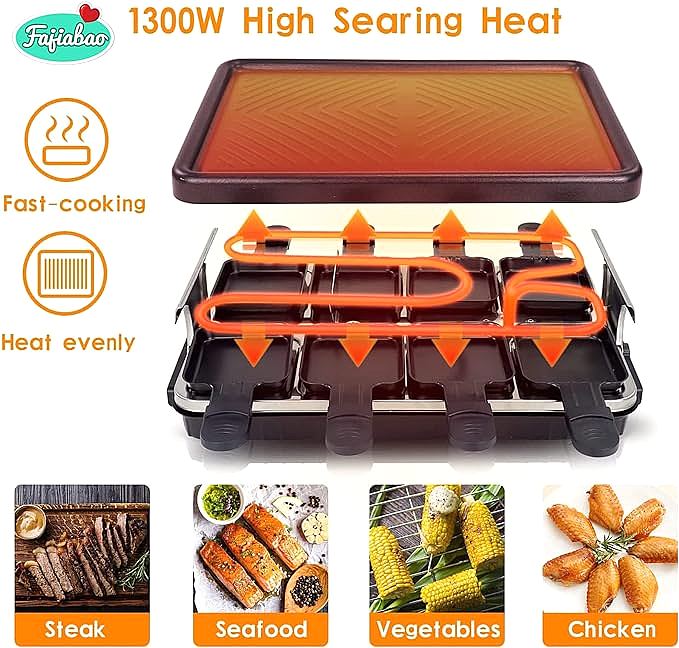
The fundamental constraint of indoor grilling is the power limitation of the standard household electrical circuit. In North America, a standard 120V outlet is typically limited to 15 or 20 amps. This puts a hard ceiling on the amount of energy available to generating heat. Most high-performance indoor grills, such as the Fajiabao SC-507, are rated around 1300 to 1500 watts.
Why is this specific wattage range ubiquitous? It is a calculation based on Specific Heat Capacity and Thermal Mass. To sear a steak effectively, the cooking surface must remain above 140°C (285°F) when a cold, wet piece of protein is placed upon it. Meat is largely water, which has a very high specific heat capacity ($4.186 J/g^\circ C$). When the meat hits the grill, it acts as a massive heat sink, rapidly draining thermal energy from the plate.
If the power input (wattage) is too low, the plate temperature plummets below the threshold for the Maillard reaction. Instead of searing, the water inside the meat begins to boil and steam out. The result is grey, rubbery meat. A 1300W heating element provides just enough “thermal inertia” and recovery speed to counteract this cooling effect, maintaining the surface temperature in the critical zone (roughly 150°C - 200°C) necessary for browning, without requiring the industrial-grade power supply of a commercial kitchen.
The Chemistry of Smoke: Managing the Smoke Point
To engineer a “smokeless” grill, one must first understand what smoke is. In a culinary context, smoke is primarily the result of Pyrolysis—the thermal decomposition of organic material (fats, proteins, carbohydrates) in the absence of oxygen, or incomplete combustion in the presence of oxygen.
Every cooking fat has a specific Smoke Point: the temperature at which it stops shimmering and starts breaking down into visible glycerol and free fatty acids, eventually producing acrolein (the compound that makes burnt oil smell acrid and irritate the eyes).
* Butter: ~150°C (302°F)
* Olive Oil: ~190°C (375°F)
* Canola/Grapeseed Oil: ~204°C-230°C (400°F-445°F)
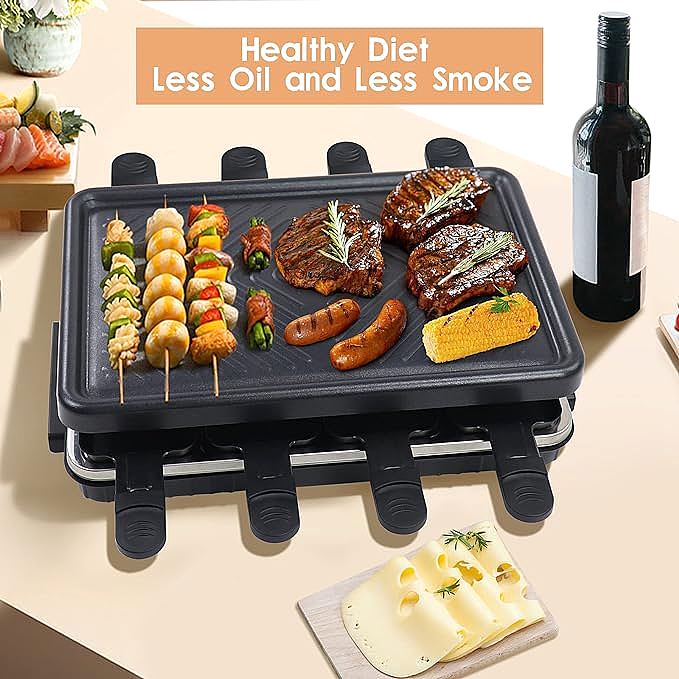
The engineering paradox is that the ideal searing temperature (150°C+) overlaps dangerously with the smoke points of many common fats. A charcoal grill solves this by simply being outdoors where the smoke doesn’t matter. An indoor electric grill must use a different strategy: Thermal Precision and Divergence.
Advanced indoor grills use thermostats with low hysteresis (lag) to keep the heating element temperature stable, preventing the runaway overheating that characterizes uncontrolled fires. By keeping the surface temperature high enough to sear protein but just below the rapid pyrolysis point of high-heat oils, these devices thread the needle between flavor and fumes.
Fluid Dynamics: The Architecture of Grease Management
The second, and perhaps more critical, source of smoke in grilling is flare-ups. This occurs when rendered liquid fat drips onto a superheated surface (like coals or a red-hot heating element), instantly vaporizing and igniting.
To prevent this, indoor grills employ specific geometric profiles. The grooved surface of the Fajiabao SC-507 is not purely aesthetic. While the ridges create the desirable char marks, the valleys serve as drainage channels. This design utilizes gravity and fluid dynamics to rapidly transport liquid fat away from the heat source.
In a well-engineered plate, the ridges are the hottest points (conductive heat transfer to the food), while the valleys are slightly cooler and angled to encourage flow. By minimizing the “residence time” of hot fat on the cooking surface, the grill reduces the probability of the fat reaching its smoke point. The fat is guided to the edges or through drain holes into a collection tray or a cooler zone where it can pool safely without vaporizing. This “source control” is the most effective way to reduce particulate emissions.
Material Science: The Role of PTFE and Thermal Conductivity
The choice of material for the grill plate is a study in compromise. The ideal material needs high thermal conductivity (to distribute heat evenly) and high specific heat (to retain heat). Aluminum is often the substrate of choice because it conducts heat significantly better than steel ($237 W/m\cdot K$ vs $\sim50 W/m\cdot K$), ensuring that the corners of the rectangular grill are as hot as the center.
However, aluminum is reactive and sticky. This brings us to the coating: Polytetrafluoroethylene (PTFE). This fluoropolymer is remarkable for having one of the lowest coefficients of friction of any solid.
* Release Properties: In a social dining context (Raclette/KBBQ), food is cooked in small batches over a long period. Without a non-stick coating, proteins would bond to the metal, creating a layer of carbonized residue (“fond”). While fond is desirable for making sauces in a pan, on a dry grill, it eventually burns, turning into charcoal and smoke. PTFE prevents this accumulation, keeping the surface clean and “smokeless” for the duration of the meal.
* Hydrophobicity: PTFE is superhydrophobic. This property aids the fluid dynamics mentioned earlier, preventing fat from pooling or spreading out into a thin film (which would heat up and smoke faster). Instead, fat beads up and rolls off the surface into the drainage channels.
Vertical Integration: Energy Efficiency in 3D
One of the unique features of the Raclette-style grill is its multi-level design. From a physics perspective, this is an exercise in energy recovery.
A typical heating element radiates energy in all directions ($360^\circ$). In a standard flat-top griddle, the downward radiation is largely wasted, heating the chassis or the table (requiring insulation). The tiered design of the Fajiabao SC-507 captures this “waste” radiant heat and puts it to work.
The upper grill plate is heated primarily by conduction (direct contact with the element) and convection (hot air currents). The lower raclette trays are heated by radiation (infrared energy emitted from the underside of the element).
* Top Zone (High Energy): Searing, boiling, rapid protein denaturation.
* Bottom Zone (Moderate Energy): Melting, warming, gentle cooking.
This cascading energy usage increases the overall thermal efficiency of the appliance. It allows the user to perform two distinct thermodynamic operations (searing and melting) simultaneously using a single 1300W source. It is an elegant example of system integration where the waste output of one process becomes the input for another.
The Human-Machine Interface: Haptic and Visual Feedback
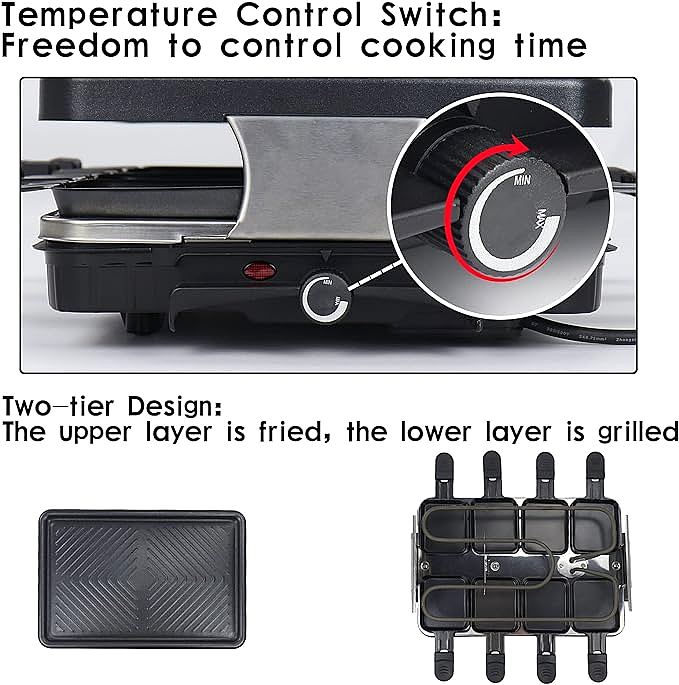
While the internal physics are complex, the user interface of these devices strives for simplicity. However, the lack of digital precision in some models (using a dial instead of a degree-specific display) is often an intentional design choice related to the nature of resistive heating.
Bimetallic thermostats, commonly used in these appliances, operate on a mechanical duty cycle. They turn the power fully ON until a temperature is reached, then fully OFF until it drops. This creates a temperature sine wave rather than a flat line. A digital display showing “375°F” might be misleading if the plate is actually fluctuating between 350°F and 400°F. A simple “Min/Max” dial acknowledges this analog reality, encouraging the user to cook by sensory feedback (sight and sound) rather than false numerical precision. This re-engages the cook’s intuition, a variable that engineering can support but never replace.
Conclusion: The Triumph of Indoor Engineering
The ability to grill a steak or melt cheese in the center of a living room without asphyxiating the guests is a triumph of modern appliance engineering. It is the result of carefully balancing electrical power limits, fluid dynamics, chemical reaction thresholds, and material properties. As we continue to densify our living spaces, technologies that allow us to manipulate high-energy physics safely and cleanly in small footprints will become increasingly vital. The indoor grill is more than a convenience; it is a sophisticated thermal engine that allows us to retain our oldest culinary traditions—cooking with fire—in a world that has largely moved beyond it.