Designing Your Soundscape: The Neuroscience of Focus and Audio Environments
Update on Jan. 4, 2026, 8:55 p.m.
In an information economy, attention is the currency of achievement. Yet, we paradoxically inhabit environments designed to fracture that very attention. The open-plan office, once heralded as a beacon of collaboration, has morphed into a theater of distraction. The modern home, now a hybrid workspace for many, is filled with the cacophony of daily life—from the hum of appliances to the distant roar of traffic. We are living through a crisis of focus, and neuroscience is beginning to reveal the invisible culprit: noise.
Our brains are not evolved for the relentless auditory input of the 21st century. While we can close our eyes to shut out visual clutter, our ears are “always on” sentinels, wired directly to our amygdala—the brain’s fear center. Every sudden sound, every snippet of intelligible speech, triggers a micro-response, a subtle shift in cognitive resources that pulls us away from deep thought. This is why the curation of one’s acoustic environment is no longer just about enjoying music; it is a fundamental pillar of cognitive hygiene and productivity. This article explores the neuroscience of sound, the high cost of noise pollution on our mental state, and how modern tools like the Phonicgrid SE7 Wireless Headphones act as essential “firewalls” for the mind.
The High Cost of Noise: Cortisol, Cognition, and the Flow State
To understand why silence (or controlled sound) is so powerful, we must look at what noise does to the brain. Research in environmental psychology and neuroscience has consistently shown that intermittent speech and variable noise are the arch-enemies of concentration.
The Cortisol Connection
Noise is a stressor. Even at moderate levels, unwanted sound triggers the release of cortisol, the body’s primary stress hormone. Chronic exposure to noise pollution—whether it’s the drone of a highway or the chatter of colleagues—keeps the body in a state of low-level “fight or flight.” This physiological arousal elevates heart rate and blood pressure, contributing to fatigue and anxiety.
When we use Active Noise Cancellation (ANC) to dampen this background chaos, we are not just blocking sound; we are physically lowering our stress baseline. By creating a sanctuary of silence, we signal to our parasympathetic nervous system that it is safe to relax, allowing mental resources to be redirected from “threat monitoring” to “creative thinking.”
The “Leaky Filter” and Cognitive Load
The human brain has a limited amount of working memory—a cognitive “scratchpad” used for processing information. Noise consumes this bandwidth. This is known as the irrelevant sound effect. Even if you are not consciously listening to a background conversation, your brain is processing the phonemes and semantics, using up energy that should be dedicated to the task at hand.
This is particularly damaging to “Deep Work”—the state of distraction-free concentration that produces high-value output. Entering a Flow State (a mental state of complete absorption) can take 15 to 20 minutes. A single auditory interruption can shatter this state, requiring another 20 minutes to re-enter. By using headphones to create a consistent acoustic barrier, we protect this fragile state, effectively “sealing” our cognitive container against leaks.
Soundscape Architect: Curating Your Audio Reality
Once we accept that noise is a pollutant, the question becomes: how do we clean it up? We cannot rebuild our offices or silence our cities, but we can engage in Soundscape Architecture. This involves using technology to curate a personal auditory bubble that supports our current objective, whether it be intense focus, relaxation, or motivation.
The Role of ANC as a Cognitive Shield
Active Noise Cancellation is the foundation of this architecture. It serves as the blank canvas. By neutralizing the low-frequency drone of the environment (the “noise floor”), ANC lowers the signal-to-noise ratio required for our brains to process information.
Technology like the Hybrid ANC found in devices like the Phonicgrid SE7 is particularly effective here. By reducing ambient noise by up to 95%, it creates a “perceptual silence.” This doesn’t mean absolute silence (which can sometimes be unnerving), but a significant reduction in the chaotic variables of the environment. This “acoustic dampening” is akin to dimming the lights in a theater—it forces the brain’s spotlight onto the main stage: your work or your thoughts.
The Soundtrack of Productivity: What to Listen To?
With the canvas cleared by ANC, what should we paint on it? Neuroscience suggests different “soundtracks” for different brain states:
* For Deep Focus: Binaural beats, white noise, or “Pink Noise” (which has a frequency spectrum similar to nature sounds like rain). These constant, non-intelligible sounds mask sudden interruptions without engaging the language centers of the brain.
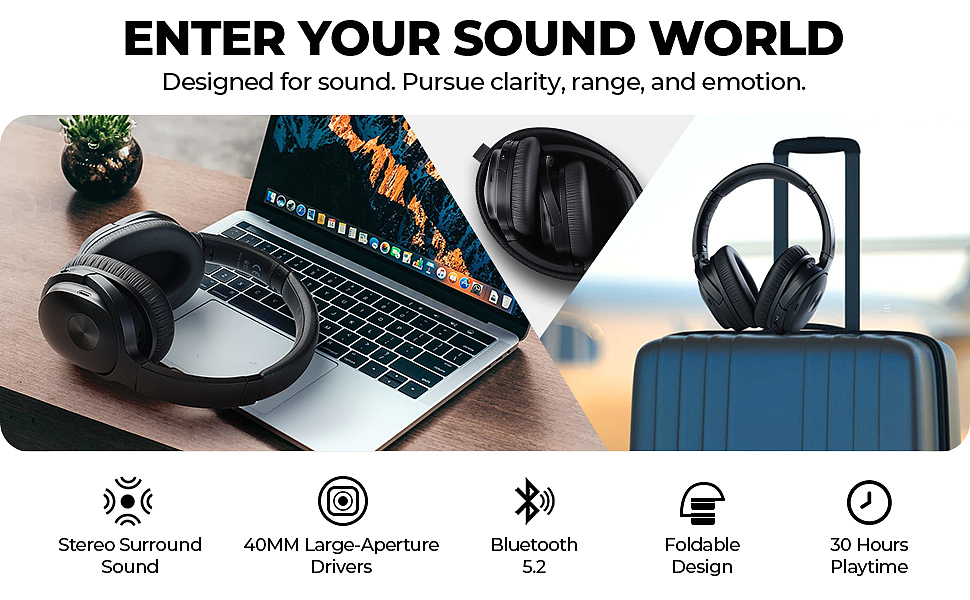
* For Repetitive Tasks: Upbeat music with a steady rhythm. This can increase arousal and mood, making boring tasks feel effortless. The SE7’s 40mm drivers and their ability to deliver “Deep Bass” shine here, providing the rhythmic drive needed to power through a spreadsheet marathon or a workout.
* For Relaxation: Nature soundscapes or ambient music. These sounds lower heart rate and promote restoration.
Ergonomics: The Physicality of Focus
It is impossible to maintain mental focus if you are physically uncomfortable. The relationship between physical comfort and cognitive performance is often overlooked in discussions about audio gear. If a headset pinches, overheats, or feels heavy, the brain registers this as a “bottom-up” distraction.
This is why the design philosophy behind products like the Phonicgrid SE7 Wireless Headphones focuses heavily on “all-day listening.” The use of lightweight materials and super imitation protein leather earcups is not just a luxury; it is an ergonomic necessity for a productivity tool.
- Pressure Distribution: A well-designed headband distributes weight evenly, preventing “hot spots” that force you to constantly readjust, breaking your concentration.
- Thermal Regulation: Breathable earcups prevent the buildup of heat and moisture, which can become major distractions during long listening sessions.
- Tactile Comfort: The soft touch of protein leather reduces sensory irritation, allowing the headphones to “disappear” from your awareness so you can focus entirely on the audio content.
The Social Signal: “Do Not Disturb” in the Modern Age
Beyond the physics and the neuroscience, wearing large over-ear headphones serves a crucial sociological function. In an open office or a busy home, they act as a universal, non-verbal “Do Not Disturb” sign.
Wearing a substantial pair of headphones like the SE7 signals to colleagues or family members that you are in a “deep work” mode. It creates a social friction that discourages trivial interruptions. This visual boundary is just as important as the acoustic boundary. It empowers the user to reclaim agency over their time and attention.
Furthermore, when communication is necessary, technology must bridge the gap seamlessly. Features like ENC (Environmental Noise Cancellation) for calls ensure that when you do step out of your focus bubble to collaborate, the transition is smooth. You don’t need to shout over background noise; the technology filters your environment for the listener, maintaining professional poise even in chaotic surroundings.

Conclusion: Reclaiming Your Mind
We live in a world that is constantly vying for our attention. Visual notifications flash, phones buzz, and the world roars. In this landscape, the ability to control what you hear is a superpower. It is the ability to create a portable sanctuary, a fortress of solitude where deep thought and creativity can flourish.
Tools like the Phonicgrid SE7 are more than just consumer electronics; they are instruments of cognitive control. By leveraging the science of Active Noise Cancellation and prioritizing ergonomic comfort, they allow us to design our own soundscapes. Whether you are using them to silence the engine of a plane, mute the chatter of a coffee shop, or simply find a moment of Zen in a busy household, you are engaging in a radical act of self-care. You are choosing to protect your brain, preserve your focus, and amplify your potential. In the end, the most beautiful sound might not be music at all—it might be the sound of your own mind, finally free to think.