A Brief History of the Thermometer: From Galileo's Glass to the Silicone Tip
Update on Oct. 21, 2025, 11:17 a.m.
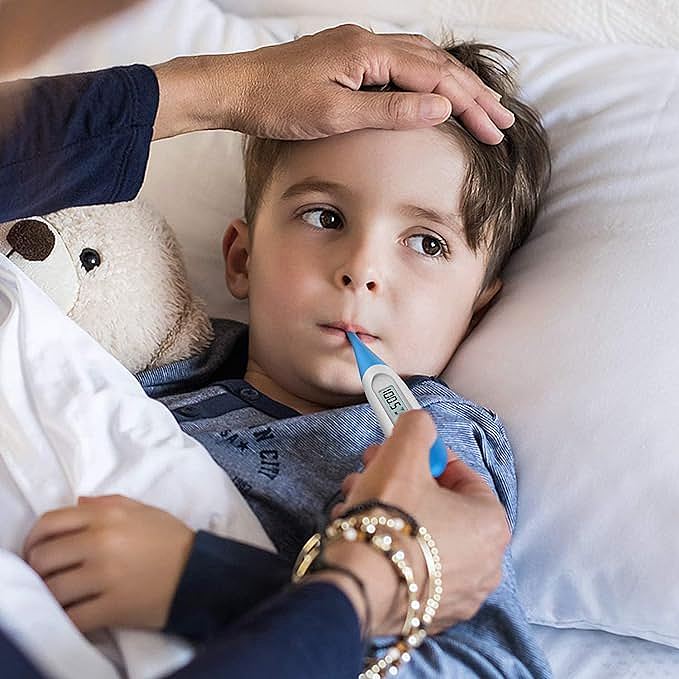
A child stirs in the night, warm to the touch. A parent reaches for a digital thermometer, places the soft silicone tip under a small tongue, and within ten seconds, a clear number on an LCD screen provides reassurance or a call to action. The entire act is simple, safe, and swift. It is an everyday miracle we take for granted.
But that small device in your hand is the culmination of a 400-year journey of curiosity, ingenuity, and a relentless quest to make the invisible visible. To understand its significance, we must travel back in time, to an era when “fever” was a mysterious internal fire, felt but unmeasured.
Act I: The Renaissance Dawn – Seeing Heat
Our story begins in the late 16th century with one of history’s great minds: Galileo Galilei. He created the “thermoscope,” a beautiful and simple device consisting of a glass bulb with a long tube extending downwards into a container of water. As the air in the bulb heated or cooled, it would expand or contract, causing the water level in the tube to rise or fall.
Galileo’s thermoscope was revolutionary. For the first time, it allowed humans to see changes in temperature. But it had a flaw: it had no scale. It could show that something was “hotter” or “colder,” but not how much hotter or colder. It was also affected by air pressure, making it unreliable. The quest for a number had just begun.
Act II: The Age of Precision – The Birth of a Scale
The next great leap came from Daniel Gabriel Fahrenheit, a Dutch-German physicist and instrument maker. In the early 1700s, Fahrenheit made two critical innovations. First, he replaced the air-and-water system with mercury, a liquid that expands and contracts much more predictably with temperature. Second, and most importantly, he created the first standardized temperature scale.
To do this, he needed fixed, reproducible points. He designated 0°F as the temperature of a freezing brine solution, and used the freezing point of plain water (32°F) and the temperature of the human body (which he initially set at 96°F) to create his scale. For the first time, a doctor in London and a scientist in Paris could talk about temperature and mean the exact same thing. The abstract concept of “heat” was now a concrete, communicable number.
Act III: The Mercury Dynasty – Fever in Your Pocket
Fahrenheit’s thermometers were large and cumbersome, taking nearly half an hour to get a reading. They were tools for the laboratory, not the home. That changed in 1867 thanks to a British physician, Sir Thomas Clifford Allbutt. He designed a portable, six-inch-long clinical thermometer that could take a patient’s temperature in just five minutes.
Allbutt’s invention was a medical game-changer. It moved temperature-taking from the hospital to the bedside. This was the device used by Dr. Carl Wunderlich to conduct his massive study, establishing 98.6°F as the benchmark for “normal.” For the next century, the glass-and-mercury thermometer reigned supreme. It was a fixture in every doctor’s bag and home medicine cabinet—a thin, fragile wand containing a shimmering line of toxic liquid metal. It was effective, but it carried an inherent risk: if it broke, the spilled mercury was a poison hazard.
Act IV: The Digital Revolution – Safety and Speed
The seeds of the next revolution were planted with the rise of electronics. While the first electronic thermometer appeared in the 1950s, it was the microchip boom of the 1970s and 80s that made them accessible. Scientists and engineers replaced the expanding mercury with a tiny, heat-sensitive component called a thermistor.
This new technology was a complete paradigm shift.
* Safety: The toxic mercury was gone, replaced by safe plastics, silicone, and stainless steel.
* Speed: Instead of waiting for a liquid to physically expand, the thermistor could detect temperature changes almost instantly, cutting measurement time from five minutes to under a minute, and eventually, to just a few seconds.
* Clarity: No more squinting and rotating a glass tube to read a fine line. A clear, unambiguous number appeared on a digital display.

Epilogue: History in Your Hands
Let’s return to the quiet bedroom. The parent looks at the number on the screen—99.2°F. In that simple, illuminated figure lies the legacy of Galileo’s curiosity, Fahrenheit’s precision, Allbutt’s practicality, and the innovation of countless anonymous engineers.
The device they hold, perhaps a Boncare thermometer, is more than just a piece of plastic and circuitry. It is a vessel of history. It represents a 400-year journey to turn a subjective feeling into an objective fact, empowering us to better care for the ones we love. The next time you use one, take a moment to appreciate the quiet miracle you hold in your hands.