Decoding the Unseen: A Technologist's Guide to Infrared Camera Specifications
Update on Oct. 8, 2025, 9:03 a.m.
Have you ever wondered why your smartphone can capture breathtaking 48-megapixel images of a landscape, yet a professional thermal camera costing hundreds of dollars might boast a resolution of only 0.07 megapixels? This vast difference isn’t a sign of inferior technology, but a clue to a fundamentally different reality. Visible light cameras capture reflected photons, painting a picture of how objects interact with an external light source. A thermal camera, on the other hand, is a passive listener. It captures the photons that objects themselves emit, painting a picture of their internal energy state. Every object above absolute zero is constantly broadcasting its thermal signature in the form of infrared radiation, a story invisible to our eyes.
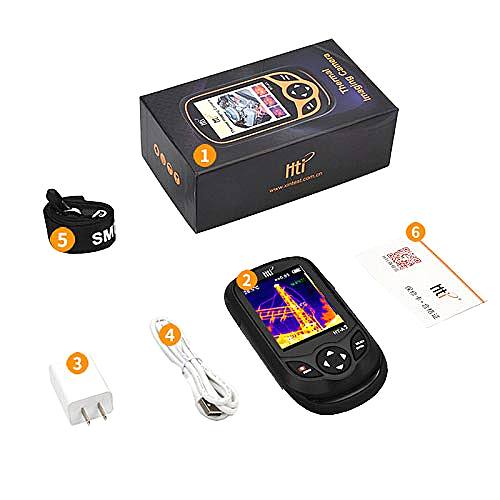
This guide will deconstruct the specification sheet of a modern, accessible thermal imager—one with a 320x240 resolution and 0.07°C thermal sensitivity—to translate its numbers into a narrative of scientific principles and engineering trade-offs. By the end, you won’t just see a list of features; you’ll understand the physics that make seeing heat possible, empowering you to evaluate any thermal device not by its marketing claims, but by its core technological truths.
The Heart of the Matter: The Microbolometer and Resolution
At the core of every modern uncooled thermal camera lies a remarkable piece of micro-engineering: the focal plane array (FPA), a grid of thousands of microscopic sensors called microbolometers.
What is a Pixel in the Thermal World? Forget the photosites in your DSLR. A thermal pixel is a tiny, thermally isolated piece of material (often vanadium oxide, or VOx) whose electrical resistance changes predictably as it absorbs heat. When infrared photons from a scene strike a pixel, it warms up by a minuscule amount, its resistance changes, and a tiny electrical signal is generated. The camera’s processor reads the signal from every single pixel and translates this grid of resistance values into a two-dimensional temperature map—the thermal image.
Resolution (320x240): The Power of Native Pixels: When a camera is listed as having a 320x240 resolution, it means it has a physical grid of 320 columns by 240 rows of these microbolometers, totaling 76,800 individual sensors. Think of it as an array of 76,800 independent, non-contact thermometers, each capturing its own precise measurement. This “native” resolution is arguably the single most important specification. It dictates the level of detail you can see. A higher native resolution means you can distinguish smaller temperature anomalies from further away, akin to having sharper vision. The difference between a 160x120 (19,200 pixels) and a 320x240 (76,800 pixels) imager is not a 2x improvement; it’s a 4x improvement in the amount of raw thermal data being captured. This is the difference between seeing a vague hot area on a circuit board and pinpointing the specific overheated resistor.
A Word on “Super Resolution”: You may see some cameras advertise a higher imaging resolution than their native detector resolution. This is typically achieved through software algorithms that use the slight, natural motion of the user’s hand to capture multiple frames and intelligently combine them into a higher-pixel-count image. While this can improve the visual quality and smoothness for general observation, it’s crucial to understand that it does not increase the number of physical sensors. For applications requiring precise temperature measurement of small targets, the native detector resolution remains the most critical figure of merit.
The Soul of Sensitivity: NETD (Noise Equivalent Temperature Difference)
If resolution is the camera’s “eyesight,” then thermal sensitivity is its “hearing.” This is quantified by a specification called NETD, or Noise Equivalent Temperature Difference, measured in milliKelvins (mK) or degrees Celsius (°C).
NETD (0.07°C or 70mK): Hearing the Thermal Whisper: NETD represents the smallest temperature difference the camera can detect. It is essentially the point at which the thermal signal from the scene is equal to the camera’s own internal electronic noise. A lower NETD is better. A camera with an NETD of 70mK (like our example) can discern temperature variations as small as 0.07°C. A camera with a 150mK NETD would be “deaf” to that same subtle difference. This is analogous to being in a quiet library versus a noisy restaurant; in the library, you can hear a pin drop, while in the restaurant, that same sound is lost in the background noise.
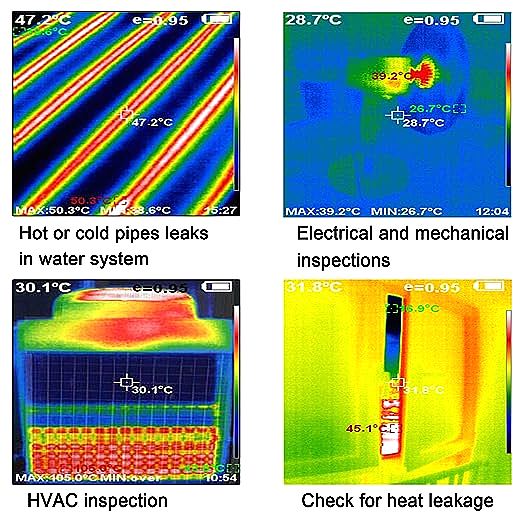
Why it Matters: While a high-temperature fault in an electrical panel is a “loud” thermal signal, many critical applications rely on detecting faint ones. Finding a subtle moisture issue behind a wall, identifying a poorly sealed window, or diagnosing a thermal bridge in a building’s structure all produce very small temperature deviations. A camera with low NETD (typically under 80mK for professional use) is essential for these tasks. It ensures that what you’re seeing is a real thermal phenomenon, not an artifact of the camera’s own noise.
The Lens on Reality: Optics, FOV, and Emissivity
A thermal camera is a system, and the world-class sensor is useless without a well-matched optical system to deliver the infrared radiation to it.
Field of View (56°x42°): Your Window to the Thermal World: The Field of View (FOV) specifies how wide an area the camera can see at a given distance. It’s determined by the lens. A wide FOV, like the 56° horizontal angle in our example, is excellent for building inspections in confined spaces, as you can capture an entire wall or ceiling without having to back up too far. Conversely, a telephoto lens with a narrow FOV would be used for inspecting distant power lines.
Emissivity (0.1-1.0 Adjustable): The Great Corrector: This is perhaps the most misunderstood—and most critical—parameter for accurate temperature measurement. Emissivity is a measure of a material’s efficiency in emitting thermal radiation, on a scale from 0 to 1. A perfect blackbody (like the opening of a furnace) has an emissivity of 1.0. A matte, non-metallic surface might be 0.95. A shiny, polished metal surface could be as low as 0.05. A low-emissivity surface not only emits poorly, but it also reflects the infrared radiation from its surroundings. Attempting to measure the temperature of a shiny object with a default emissivity setting will result in a grossly inaccurate reading, as the camera will be measuring a mix of emitted and reflected energy. A professional thermal instrument must have adjustable emissivity, allowing you to tell the camera what kind of surface it’s looking at, thereby correcting its calculations for a precise measurement.
The Supporting Cast: Frame Rate and Spectral Range
While resolution and sensitivity are the stars, other specifications play crucial supporting roles.
Frame Rate (9Hz): Why Not 60fps? The frame rate is how many times per second the camera updates the image. Most handheld commercial thermal cameras operate at or below 9Hz. This is not a technical limitation but a regulatory one. Thermal cameras with frame rates above 9Hz are often subject to stringent international export controls due to their potential for military applications. For most diagnostic tasks, which involve scanning static or slow-moving targets, 9Hz is perfectly adequate and provides a smooth-enough image for effective inspection.
Spectral Range (8-14µm): The “Atmospheric Window”: A thermal camera does not see all infrared wavelengths. It operates within a specific band, typically 8 to 14 micrometers (µm). This is known as the long-wave infrared (LWIR) band, or the “atmospheric window.” The Earth’s atmosphere is largely transparent to IR radiation in this specific range, allowing thermal energy from distant objects to reach the camera sensor with minimal absorption by air, water vapor, or CO2. This is why a thermal camera can be used effectively over long distances, whereas a camera operating in a different IR band would have its “vision” obscured by the atmosphere itself.
Conclusion: The Empowered Technologist
A specification sheet is more than a list of numbers; it’s the blueprint of a tool’s capabilities. By understanding that resolution dictates detail, NETD defines sensitivity, and emissivity governs accuracy, you are equipped to look past marketing and truly comprehend the power and limitations of a thermal imaging device. This knowledge transforms you from a passive consumer into an empowered technologist, capable of selecting and utilizing tools based on the fundamental principles of the tasks they are meant to perform. The unseen world has a language, and you now have the key to its grammar.