A Practitioner's Field Guide to Pocket Thermography: From Diagnosis to Action
Update on Oct. 8, 2025, 8:55 a.m.
You’ve been there. The persistent, nagging draft no amount of caulking seems to fix. The circuit breaker that trips for no apparent reason on hot days. The faint, musty smell in the basement corner you can’t trace. These are the phantom problems that mock our five senses, existing just beyond the threshold of normal perception. For decades, diagnosing them was a game of educated guesses, often involving costly and destructive exploratory work. That era is over.
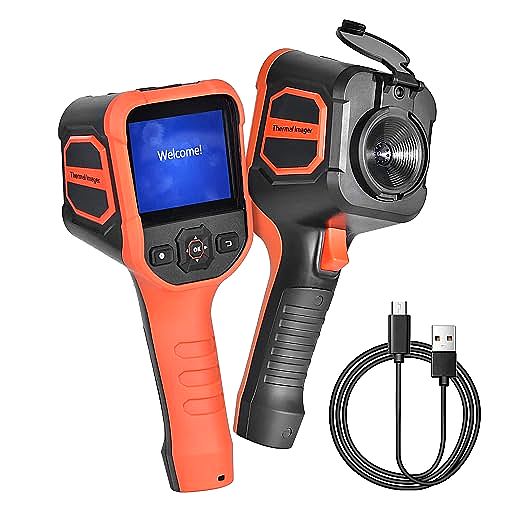
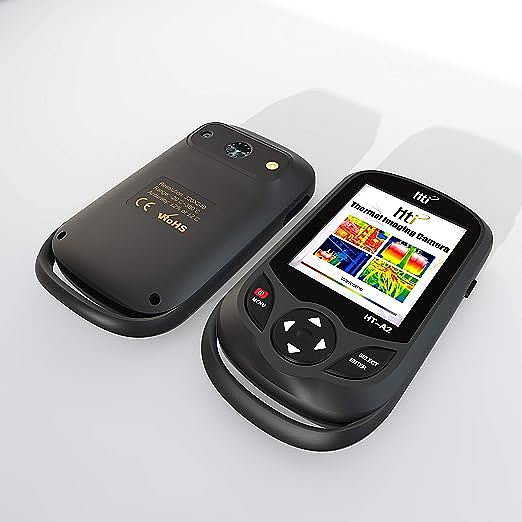
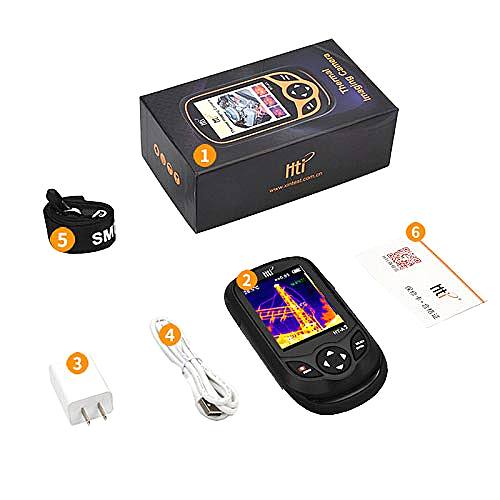
The power to see the unseen world of heat has rapidly moved from million-dollar military contracts to the tool belts of discerning professionals. Leading this charge is the rise of the robust, pocket-sized thermal camera—a standalone device built for the rigors of the field. While smartphone plug-ins have their place, a dedicated imager offers a more resilient workflow; you’re not risking your personal phone in a dusty crawlspace, nor are you at the mercy of app crashes or a drained phone battery halfway through an inspection. This guide is built around the capabilities of a representative workhorse from this new generation: a pocketable camera featuring a crisp 320x240 native infrared resolution and a versatile -20°C to 300°C temperature range. It’s not about this specific brand; it’s about what this class of tool empowers you to do. We’ll explore how to translate its thermal images into actionable intelligence, turning you from a technician into a diagnostician.
Reading the Language of Heat: The Five Fundamental Patterns
A thermal imager doesn’t just show you “hot” and “cold”; it reveals the narrative of energy in motion. With experience, you’ll begin to recognize recurring patterns that tell specific stories. Mastering these five fundamental thermal signatures is the first step toward fluency.
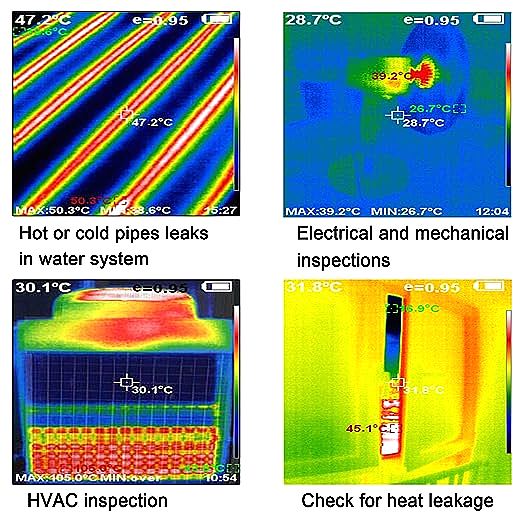
- The Cold Spot Anomaly: Often appearing as a dark, amorphous shape against a warmer background (in most palettes), this is the classic signature of missing insulation or, more critically, moisture. Water is a better thermal conductor than most building materials, and the effect of evaporative cooling makes damp areas appear significantly colder.
- The Hot Spot Anomaly: A bright, concentrated point of heat. This is the tell-tale sign of excess energy, most commonly due to electrical resistance in a faulty connection or friction in a failing mechanical part like a motor bearing.
- The Plume: A distinctive, feather-like or flowing pattern, indicating air leakage. You’ll see cold air plumes infiltrating a building envelope in winter through gaps in window seals or unsealed outlets, a direct visualization of your energy loss.
- The Defined Linear Pattern: A clear, straight or angled line of different temperature. This almost always corresponds to a physical structure hidden within a wall or ceiling—a hot water pipe, a cold water line, an HVAC duct, or even wall studs acting as thermal bridges in an otherwise insulated wall.
- The Irregular Gradient: A slow, uneven change in temperature across a surface. This often indicates widespread thermal bridging or areas with subtle, compressed, or settled insulation that hasn’t failed completely but is underperforming.
A capable imager enhances your ability to spot these patterns by using various color palettes. A “Rainbow” palette is excellent for seeing the full temperature spectrum at a glance, while a high-contrast palette like “Ironbow” or “White Hot” can make a subtle hot spot pop, making it easier to pinpoint the exact location of a problem before it becomes a catastrophic failure.
The Building Envelope Inspection: A Systematic Walkthrough
Your primary use of a pocket thermal camera will often be assessing the health of a building’s thermal envelope. A systematic approach is key. For best results, you need a temperature differential (Delta T) of at least 10°C (about 20°F) between the inside and outside.
Insulation Voids and Deficiencies: In a heated building during cooler weather, scan interior walls, ceilings, and floors. Missing insulation will appear as distinct, colder geometric shapes—often dark blue or purple blotches in a rainbow palette. A thermal sensitivity (NETD) of 0.07°C, as found in our example device, is more than sufficient here. It means the camera can discern temperature differences as small as 0.07°C, allowing you to see not just gaping voids but also areas where insulation has settled or become compressed.
Air Leakage Detection: Depressurize the house if possible (e.g., by running all exhaust fans) to exaggerate air infiltration. Scan the common culprits: window and door frames, electrical outlets on exterior walls, recessed lighting, and where the foundation meets the wall. You are looking for the “plume” pattern—the feathery streaks of cold air being sucked into the building. This is a direct, visual confirmation of a leak that needs to be sealed.
Moisture Detection: This is a powerful but nuanced application. Thermal imagers do not see moisture; they see temperature differences caused by it. As water evaporates, it cools the surface, making it stand out as a cold spot. Look for anomalous cold patterns that don’t conform to the building’s structure. It’s crucial to remember that this is a diagnostic first step. Once you identify a potential moisture spot with the imager, you must confirm it with a moisture meter. This two-step process is the mark of a true professional.
Inside the Wires: Electrical and Mechanical Surveys
Thermography’s ability to instantly spot excess heat makes it an indispensable tool for non-contact electrical and mechanical inspections, significantly enhancing safety.
The Delta-T Rule of Thumb: When scanning an electrical panel, you’re looking for connections (lugs, breakers) that are hotter than similar components under similar load. Industry standards, like those from NETA, provide detailed severity criteria. For a practical field approach, a connection that is 10°C-20°C hotter than ambient or surrounding components warrants investigation, while anything hotter than that requires immediate attention. A thermal camera with a temperature range up to 300°C (572°F) provides ample headroom for most residential and light commercial electrical work.
Safety and Efficiency: The beauty of this process is that it’s done while the system is energized and under normal load, revealing problems that would be invisible during a shutdown. You can scan an entire panel in seconds without opening the deadfront, identifying potential fire hazards before they escalate. The same principle applies to motors, pumps, and bearings. A hotspot on a motor housing can indicate an impending failure long before it’s audible.
A Tool’s Honesty: Understanding Limitations and Verifying Findings
An effective diagnostician knows the limits of their tools. A thermal camera is not an x-ray machine, and misinterpreting an image can be worse than not having one at all.
The Emissivity Trap: Different materials emit thermal energy at different rates. This property is called emissivity. A matte black surface has an emissivity close to 1.0, while a shiny, metallic surface might be 0.1. If you point a camera with a fixed emissivity setting (often 0.95) at a shiny copper busbar, the temperature reading will be wildly inaccurate. A professional-grade tool, even a pocket-sized one, must allow for adjustable emissivity. Before measuring, always adjust the setting to match the material, or for a quick and accurate reading on a low-emissivity surface, apply a small piece of high-emissivity material, like black electrical tape.
Reflections Can Lie: Low-emissivity (shiny) surfaces don’t just emit poorly; they act like thermal mirrors. You might be looking at a cool electrical conduit but seeing the reflection of your own warm face. Always change your viewing angle to see if the “hot spot” moves. If it does, it’s a reflection.
The Visible Light Companion: Many thermal cameras offer a feature to blend a thermal image with a standard visible-light image to provide context. While industry-leading systems create a sharp, well-aligned overlay, this is an area where budget-friendly models often compromise. The thermal imaging core of our example device is excellent for its class, but you may find its visible camera image is of lower quality and not perfectly aligned with the thermal overlay. My field advice is simple: rely on the device for its core strength—the high-quality infrared image. Use your smartphone to take a separate, high-resolution visible photo for your reports. This workflow leverages the best of both worlds.
Conclusion: From Seeing to Solving
A pocket-sized thermal camera with professional specifications is no longer a luxury; it is a fundamental diagnostic tool. It empowers you to stop guessing and start seeing. By learning to read the language of heat, systematically inspecting for anomalies, and respecting the tool’s limitations, you elevate your craft. The goal is not just to find a hot or cold spot. It’s to understand the story that spot is telling, and to use that knowledge to build, repair, and maintain with greater precision and confidence than ever before.